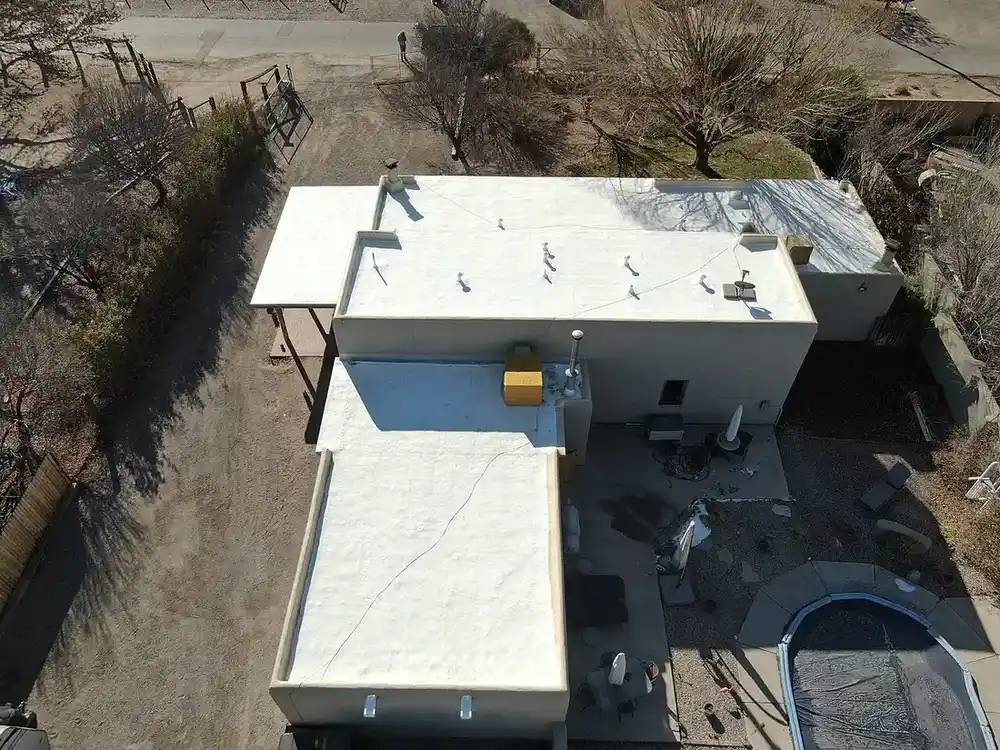
A foam roof is only as good as the coating over it: spray foam cannot face Albuquerque's UV alone, so the coat is renewed every five to seven years - that cycle IS the roof's lifespan plan.
Problem: A foam roof is only as good as the coating over it: spray foam cannot face Albuquerque's UV alone, so the coat is renewed every five to seven years - that cycle IS the roof's lifespan plan.
Solution: Read the coat yearly - chalking, thinning, cracks and pits - and recoat while the foam beneath is still sound and dry, when the job is a renewal instead of a rebuild.
When to call: Call when foam color shows through the coat, when the surface chalks heavily or cracks, or when the last recoat date is unknown - an unrecorded foam roof is an overdue one.
Foam roofing confuses owners because its lifespan gets quoted two ways: 'the foam lasts for decades' and 'it needs work every five to seven years'. Both are true, and the reconciliation is the coating. The foam is the body; the coating is the skin; and in Albuquerque's sun, skin is a renewable resource. This guide explains the cycle - what the coat does, how it ages, how to read its condition, and how the economics of foam reward owners who keep the schedule and punish those who let it slide.
The Albuquerque Angle
The city's roofscape matches the climate: flat pueblo-style roofs draining through canales and scuppers, pitched tile in the suburbs, shingles on the postwar neighborhoods, foam and coated roofs all over, and metal standing up to snow in the mountains. Each system fails in its own Albuquerque way, and the pages here are organized around exactly that.
What the Coating Actually Does
Unprotected spray foam under mile-high UV degrades visibly and fast - yellowing, then orange, then a pitted, eroding surface losing material season by season. The elastomeric coating sprayed over it is engineered to take that beating instead: it is the UV shield, the waterproofing skin and the impact layer in one. Every other part of the foam roof system - the insulation value, the seamlessness - depends on that skin staying intact.
Coatings themselves are spent by the job they do. Sun chalks and thins them; ponding areas wear them faster; hail pits the surface and sometimes the foam beneath. The standard planning window in this climate is five to seven years per coat, judged by condition rather than the calendar alone. A foam roof is therefore never 'done' - it is a roof on a subscription, and the subscription is the price of its considerable virtues.
Reading Your Coat: The Owner's Checklist
You can read a foam roof's coat from a ladder or a careful look at its edges. Healthy coat is uniform in color, slightly rubbery to the touch, and unbroken. Warning signs, in rough order: surface chalk that comes off white on a hand; color variation where foam tones show through; fine cracks, especially at ponding areas and detail points; blisters; and worst, orange or brown exposed foam - that is the coat already gone in that spot and foam being spent.
Ponding areas deserve the closest look, because water stands on the coat there and works it hardest; hail-prone seasons add pitting to check. The attic and ceilings complete the read: any new stain under a foam roof whose coat is failing is treated as water in the foam until a moisture check says otherwise - foam hides its water well, and assumptions are how small recoats become rebuilds.
PROBLEM
→
SOLUTION
The Economics of On-Time vs Late
A recoat on sound, dry foam is the simplest job in roofing: clean, repair small damage, spray the new coat to thickness. Every year of delay past the coat's life taxes that simplicity. First the repairs grow - cracks to cut out, pits to fill. Then moisture enters the foam at the breaks, and wet sections must be removed and rebuilt before coating can proceed. Left long enough, the foam itself erodes and thins, and the renewal becomes a re-foaming or a tear-off.
Run the comparison honestly and the schedule wins by a wide margin: a lifetime of timely recoats costs a fraction of one replacement, and keeps the roof continuously watertight in between. This is the entire foam bargain in one paragraph - the system trades the big, rare expense of other roofs for a modest, regular one, and it keeps its side of the bargain exactly as long as the owner keeps theirs.
What a Recoat Day Actually Looks Like
The crew starts with condition work: pressure-washing or cleaning the surface, cutting out damaged or wet foam and rebuilding those areas to thickness, sealing detail points, and masking what should not be coated. Then the coating is sprayed - or rolled on smaller roofs - in passes to the specified total thickness, with wet gauges checked as it goes. Cure time follows before traffic is allowed.
Homeowners are sometimes surprised that recoating takes longer in the prep than in the spraying. That ratio is correct and healthy: adhesion is made in the preparation, and the coat's years are decided before the first gallon opens. A recoat quoted as a one-hour spray should prompt the same question as any too-fast work - what, exactly, was skipped?
Choosing the Coating: Acrylic, Silicone, Urethane
Acrylic elastomerics are the workhorse - economical, reflective, easy to renew again later - and they ask for a roof that drains, since standing water is their weakness. Silicone shrugs off ponding and UV with minimal chalking, costs more, and commits the roof to silicone forever after, since little else adheres to it. Urethanes are the tough skin for traffic areas and ponding abuse. Many Albuquerque foam roofs run a map: silicone where water stands, acrylic across the field.
The applicator's job is to make that map from your roof's drainage reality, not from a house brand. Ask which product goes where and why, and what thickness - a recoat conversation that cannot name mils is not finished yet.
Myth vs Fact
The Myth
A foam roof is maintenance-free - the salesman said the foam lasts fifty years. The foam might; the roof system does not, and the confusion is the most expensive one in foam ownership.
VS
The Fact
The coating is a consumable with a five-to-seven-year Albuquerque life. Foam's decades are delivered in recoat installments. Owners who budget the cycle get the fifty years; owners who believed 'maintenance-free' get a rebuild.
The Related Service, In Depth
Foam is best understood as a roof you garden rather than a roof you own outright. Its surface is alive in the sense that it must be renewed on a cycle, and its failures come from lapses of attention rather than from single events. The owners who love their foam roofs - and many do, for decades - are the ones who put the recoat on the calendar the day the foam went down.
That is the service side of this guide's subject. When you are ready, the Foam Roofing page carries the process, the coverage by neighborhood and the number to call.
The Process, Step by Step
Find the last recoat date
Paperwork, invoices, or the previous owner's records - the roof's clock starts from a known date or it is assumed overdue.
Read the coat's condition
Chalk, thinning, cracks, blisters and exposed foam graded across the roof, ponding areas first.
Verify the foam is dry
Moisture scan or core samples where the coat has failed - the fact that separates recoat from rebuild.
Recoat to specification
Repairs first, then the new coating at its rated thickness, with the date recorded for the next cycle.
Prevention Checklist
Put the recoat year on the house calendar the day the coat goes on.
Fix coating breaks - pecks, pits, cracks - as they appear, not at the next cycle.
Keep drainage clear; ponding shortens a coat's life exactly where it stands.
Keep traffic off the roof or on walk pads; dents in foam become coat failures.
Keep every coating record: date, product and thickness, for the next owner and the next applicator.
A Field Checklist for Your Own Home
Every spring
walk for pits, cracks and blisters; photograph and date what you find.
After hail
inspect before the sun turns fresh pits into foam damage.
Keep the recoat paperwork
product, thickness, date - the next cycle's starting point.
Never let another trade park ladders or materials on unprotected foam.
What the Paperwork Should Show
A recoat quote should state the findings first - foam condition, moisture results, damaged areas to rebuild - then the coating system by area, the total dry-film thickness in mils, the detail work included, and the prep steps the price assumes.
If a quote names none of these, it is pricing a spray, not a recoat. The difference shows up in year three, which is precisely when the conversation is hardest to have.
How a Professional Works This Problem
Professionals moisture-scan before they recoat, and they publish the thickness they applied. Those two habits - verify the core is dry, prove the skin's depth - are the whole difference between a recoat that resets the roof's clock and a cosmetic spray that traps the past under a fresh color. Ask for both, by name, before the work is scheduled.
Mistakes That Make It Worse
Spraying coating over wet or damaged foam and sealing the problem in.
Quoting a recoat with no mil thickness stated anywhere.
Walking the foam in hard soles or dragging equipment during the job itself.
Letting the cycle slip 'one more year' repeatedly - the compounding is the entire risk.
The Bottom Line
Foam roofs reward the owners who treat the coating as the consumable it is - a five-to-seven-year skin renewed on schedule for a fifty-year core. If you do not know your coat's age or thickness, that is the finding, and a short call starts the read that answers both.
Hail damage is mostly invisible from the ground - it bruises shingles, cracks tile, pits foam and loosens fasteners, and the proof lives in a hands-on inspection with dated photos.
A flat roof is not a lid - it is a water-management system with a slight slope, drains through the parapet, and a membrane and coating that must stay sound under permanent sun.
What if I do not know when my foam roof was last coated?
Treat it as due for an inspection and go by condition. The coat's chalk, thickness and cracking tell an applicator its approximate age within a range - and if the coat is already failing anywhere, the answer is the same regardless of the date. Going forward, the fix is a dated record from your recoat.
Can I recoat a foam roof myself with store products?
Small coating touch-ups, yes, with compatible products. A full recoat is spray equipment, thickness control and prep work - the differences between a five-year coat and a ten-year one are applied thickness and surface preparation, and both are professional skills. The product in the bucket is the smallest part of the job.
Does a recoat add insulation or change the roof's R-value?
A standard recoat adds negligible insulation - the foam beneath is the insulation, and it is unchanged. What the recoat restores is waterproofing, UV protection and reflectivity, which is where the foam's comfort story actually lives: a fresh light coat also drops the roof's surface temperature sharply versus a worn, darkened one.
How do I know if moisture is inside my foam roof?
Signs above (blisters, persistent soft spots) and evidence below (stains that keep growing) suggest it, but the settlement comes from a moisture scan or a core sample cut and read by the applicator. It is a small intrusion that answers the biggest question in foam work - insist on it before any recoat is quoted as simple.
Please note: Albuquerque Roofing Pros is an independent directory and referral service, not a roofing contractor. The professionals reachable through this site are independent businesses; any agreement for work is between you and the professional you engage. Service information on this site is general educational material - the scope of any real roofing work is set by an on-site inspection.
A Leak Over the Living Room, Tiles on the Driveway or a Flat Roof Holding Water?
One call connects you with a roofing professional serving Albuquerque and the surrounding communities - inspection, repair, replacement and upkeep.